

The American job market is quietly fracturing beneath the surface.
This morning, Goldman Sachs abruptly raised its U.S. recession probability to 30%.
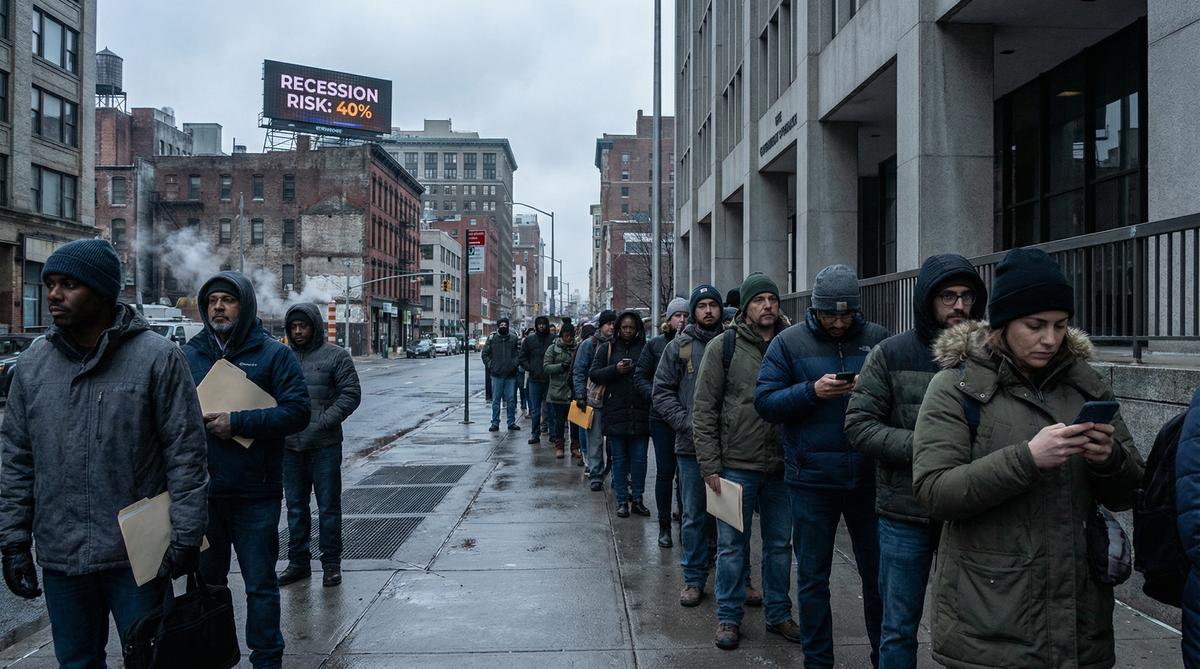
Other major financial institutions are even more alarmed, with EY-Parthenon now putting the odds of an economic downturn at a staggering 40%.
But you don’t need Wall Street analysts to tell you what is happening on Main Street.
According to a devastating new Gallup survey released today, 72% of Americans say it is a “bad time” to find a new job.
For the first time since Gallup began tracking the data, more U.S. workers report they are “struggling” (49%) than “thriving” (46%).
The hiring rate has plummeted to 3.2%—the absolute lowest level we have seen since March 2013.
And the manufacturing sector, once the bedrock of the middle class, has hemorrhaged 98,000 jobs in just the last 12 months.
The economic engine is stalling, and the people at the top are already positioning their lifeboats.
When the layoffs accelerate and the unemployment lines swell, the government will not save you.
Your corporate employer will not hesitate to cut your position to protect their bottom line.
If your entire financial survival depends on a single paycheck from a fragile corporation, you are standing on a trapdoor.
And the lever is about to be pulled.
The Reality Check: Why Standard Financial Advice is a Trap
Mainstream financial advisors have been selling you a dangerous lie.
They tell you to build a three-month emergency fund in a traditional savings account.
They tell you to invest in a diversified portfolio of index funds and wait for retirement.
They tell you that a college degree and corporate loyalty are the keys to long-term security.
In a stable economy, that advice is mediocre. In a collapsing economy, it is fatal.
When inflation surges and the dollar loses its purchasing power, your savings account becomes a melting block of ice.
When the stock market violently corrects, your 401(k) can lose a decade of growth in a matter of weeks.
And when the supply chains break and the cost of basic necessities skyrockets, a piece of paper from a university will not put food on your table.
Relying on the traditional financial system means you are outsourcing your survival to institutions that do not care if you starve.
You are trusting a banking system that requires constant bailouts just to stay afloat.
You are trusting a government that is currently drowning in $34 trillion of national debt.
True security cannot be outsourced.
If your income disappears tomorrow, you cannot eat your stock portfolio.
You cannot barter with a digital bank balance when the grid goes down or the ATMs freeze.
The only wealth that matters in a crisis is the wealth you can control, defend, and produce with your own two hands.
The Practical Solution: Building Unbreakable Income Streams
To survive the coming economic storm, you must decouple your livelihood from the fragile corporate matrix.
You must build recession-proof income streams that rely on tangible skills, local networks, and hard assets.
This is not about starting a tech company or day-trading crypto.
This is about mastering the foundational skills that people will always need, regardless of what the stock market is doing.
First, you must develop high-value, localized barter skills.
When fiat currency fails, the local economy reverts to the oldest system in human history: trade.
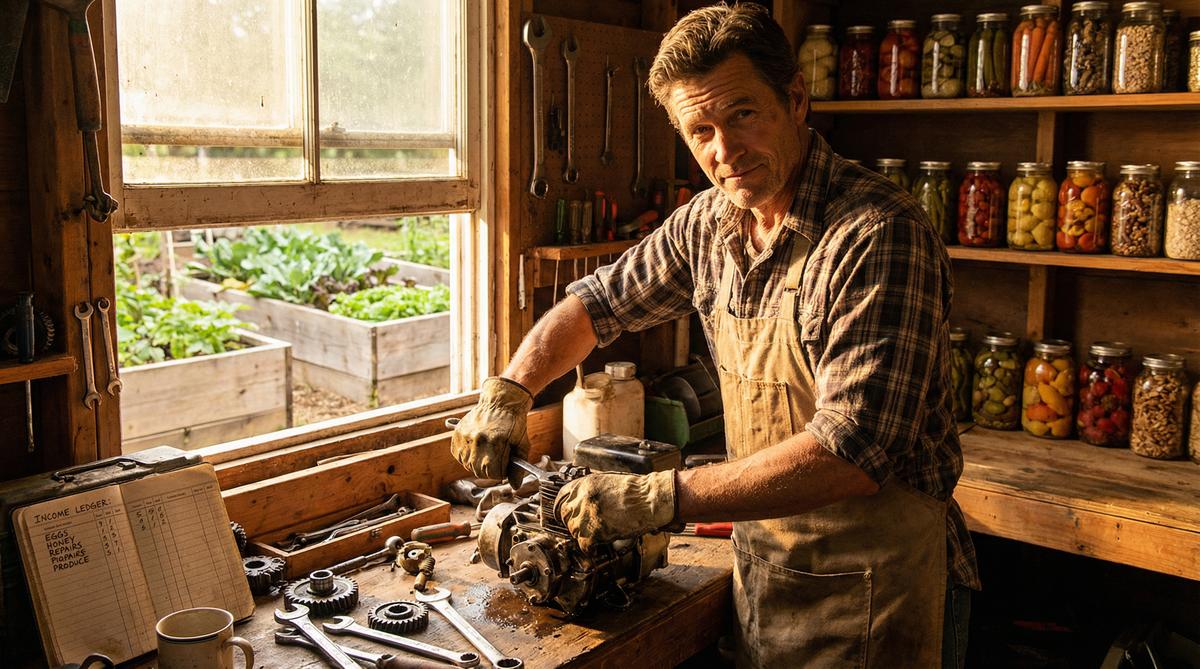
If you know how to purify water, repair small engines, or preserve food, you possess a currency that cannot be inflated away.
Learn how to weld, how to build off-grid solar arrays, or how to perform basic field medicine.
These are the skills that make you indispensable to your community when the supply chains snap.
Second, you must turn your property into a center of production.
A suburban backyard or a rural homestead should not be a financial drain—it should be an economic engine.
Start cultivating high-yield, calorie-dense crops that can be stored long-term or traded locally.
Raise chickens for a continuous supply of protein, or learn the art of seed saving to ensure your food supply never runs out.
When grocery store shelves sit empty, the person who controls the food supply controls their own destiny.
Third, you must establish decentralized, hard-asset wealth.
Do not leave all your capital trapped in digital banking systems that can be frozen with a keystroke.
Convert a portion of your vulnerable fiat currency into physical precious metals like gold and silver.
Stockpile essential bartering items: medical supplies, ammunition, heirloom seeds, and water filtration equipment.
In a severe downturn, a case of antibiotics or a bucket of viable seeds will be worth more than a stack of hundred-dollar bills.
You must become your own bank, your own grocery store, and your own utility company.
The Path to Resilience: From Vulnerability to Sovereignty
The economic data is terrifying, but fear is a useless emotion if it does not drive you to action.
The fracturing of the traditional economy is not just a threat—it is an unprecedented opportunity to reclaim your independence.
For decades, we have been conditioned to be dependent consumers.
We have been taught to rely on fragile supply chains, bloated corporations, and incompetent politicians.
Now is the time to become a sovereign producer.
When you build multiple streams of resilient income, you strip the system of its power over you.
You no longer have to lie awake at night worrying about corporate layoffs or stock market crashes.
You no longer have to panic when you see the price of groceries doubling at the checkout counter.
Because you know that your family’s survival is secured by your own skills, your own assets, and your own preparation.
Building this level of resilience requires hard work, discipline, and a willingness to step outside the comfort zone of the modern matrix.
But the peace of mind that comes with true financial sovereignty is worth every ounce of effort.
You are not just preparing to survive a recession.
You are building a fortress that will protect your family for generations to come.
The storm is already breaking on the horizon.
The only question is whether you will be caught out in the open, or standing safely inside the stronghold you built.
The Blueprint for Independence
Your journey to total financial and physical sovereignty begins with taking immediate, decisive action today.
If you want to completely insulate your family from the collapsing commercial food supply, you need to master the art of high-yield, low-space cultivation by implementing the 4ft Farm Blueprint.
To ensure your property is equipped with the rugged, off-grid tools necessary to maintain your independence when the power grid fails, secure your essential gear through Homesteader Depot.
For continuous, master-level intelligence on navigating the escalating threats to our infrastructure and economy, you must arm yourself with the strategies detailed in the Self Reliance Report.
To understand the deep political and financial currents driving this economic crisis so you can stay three steps ahead of the collapse, follow the unfiltered analysis at American Downfall.
Because true resilience requires a body capable of enduring extreme stress, you must optimize your physical vitality using the natural, ancestral protocols found at Seven Holistics.
And to break free from a fragile, pharmaceutical-dependent medical system that is already experiencing catastrophic shortages, build your foundation of medical independence with Freedom Health Daily.
The system is cracking.
Your independence is the only asset they cannot take away.
Build it now.