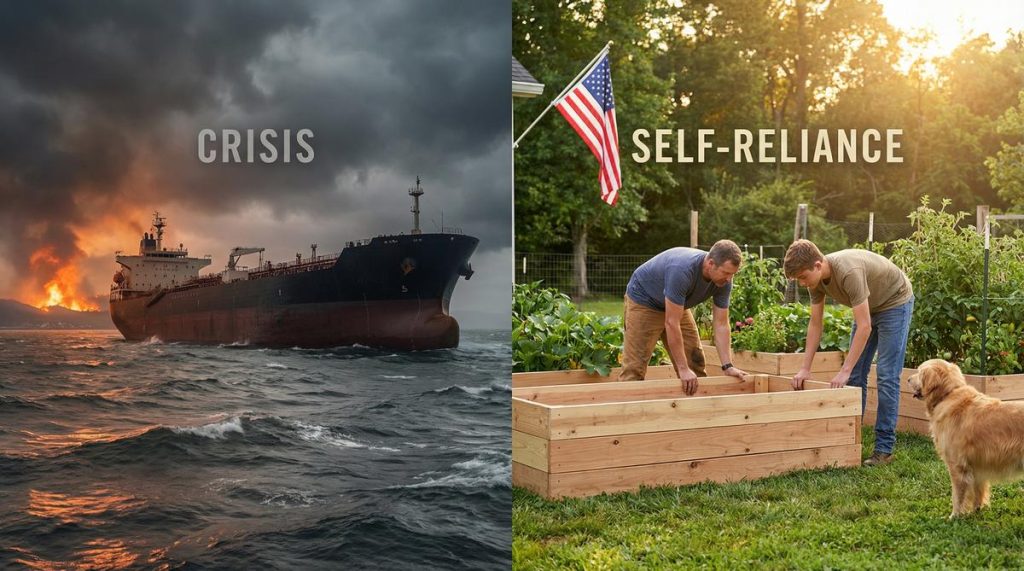
The fertilizer that grows your food is currently stuck in a war zone.
Right now, tanker traffic through the Strait of Hormuz has collapsed by over 95 percent.
That single stretch of water carries up to 30 percent of all internationally traded fertilizers.
It also accounts for nearly half of the global sulfur trade — the critical ingredient needed to process phosphate rock into the fertilizer that keeps American crops alive.
And this crisis is hitting at the exact moment American farmers are putting seeds in the ground.
The United Nations Food and Agriculture Organization (FAO) just issued a severe warning.
Middle East granular urea prices spiked 19 percent in the first week of March alone.
Egyptian urea prices surged 28 percent.
War-risk insurance premiums for cargo ships have skyrocketed from 0.25 percent to as high as 10 percent of the vessel’s total value.
The FAO projects global fertilizer prices could average 15 to 20 percent higher in the first half of 2026.
This is not just an energy shock. It is a systematic shock to the global food supply.
Because fertilizer use follows a nonlinear yield response, even a modest reduction in application means a disproportionately massive collapse in crop yields.
Industry analysts are already warning that global food prices could rise 12 to 18 percent by the end of 2026.
And that is on top of the 29.4 percent increase in grocery prices we’ve already suffered since 2020.
Beef prices are already up 14 percent year-over-year.
The era of cheap, abundant, on-demand food is officially over. If you haven’t already started preserving your own food through home canning and fermentation, the time to start is now.
The Reality Check: Why You Cannot Rely on the Supply Chain
Most Americans believe the grocery store will always be there.
They assume that if prices go up, they will just complain, adjust their budget, and keep buying.
But what happens when the food simply isn’t there to buy?
The modern agricultural system is a fragile, just-in-time machine.
It requires cheap natural gas to synthesize nitrogen.
It requires cheap diesel to run the tractors and the transport trucks.
It requires open, safe shipping lanes to move millions of tons of raw materials across the globe.
Right now, every single one of those pillars is fracturing simultaneously.
When fertilizer prices spike, farmers don’t just pay more.
They apply less.
They switch to crops that require fewer nutrients.
They leave marginal land unplanted.
The result is a mathematical certainty: less food harvested in the fall.
You cannot rely on the government to fix a global supply chain collapse.
You cannot rely on price controls to magically produce wheat and corn out of thin air.
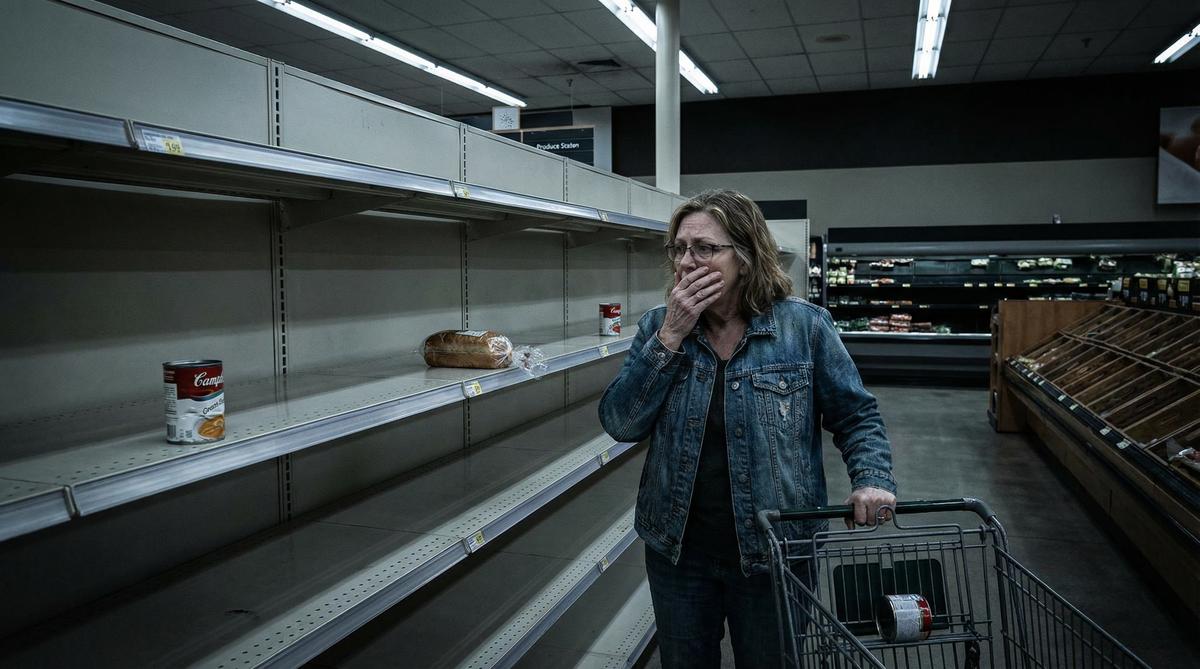
And you certainly cannot rely on your local supermarket, which only holds about three days of inventory at any given time.
If you are waiting for the system to stabilize, you are making a fatal miscalculation.
The system is not stabilizing. It is resetting to a permanently higher baseline of scarcity and cost.
The Practical Solution: The 60-Day Backyard Food Production System
You have a brief, closing window to decouple your family from this collapsing system.
The solution is not to hoard more expensive groceries.
The solution is to become a producer, not just a consumer.
You need to build a high-yield, low-footprint food production system on your own property.
And you need to do it right now, while the spring planting window is still open.
Here is the exact blueprint to generate six months of caloric security in your own backyard.
Step 1: The High-Density Raised Bed Strategy
Do not tear up your entire lawn.
Traditional row gardening is a massive waste of space, water, and labor.
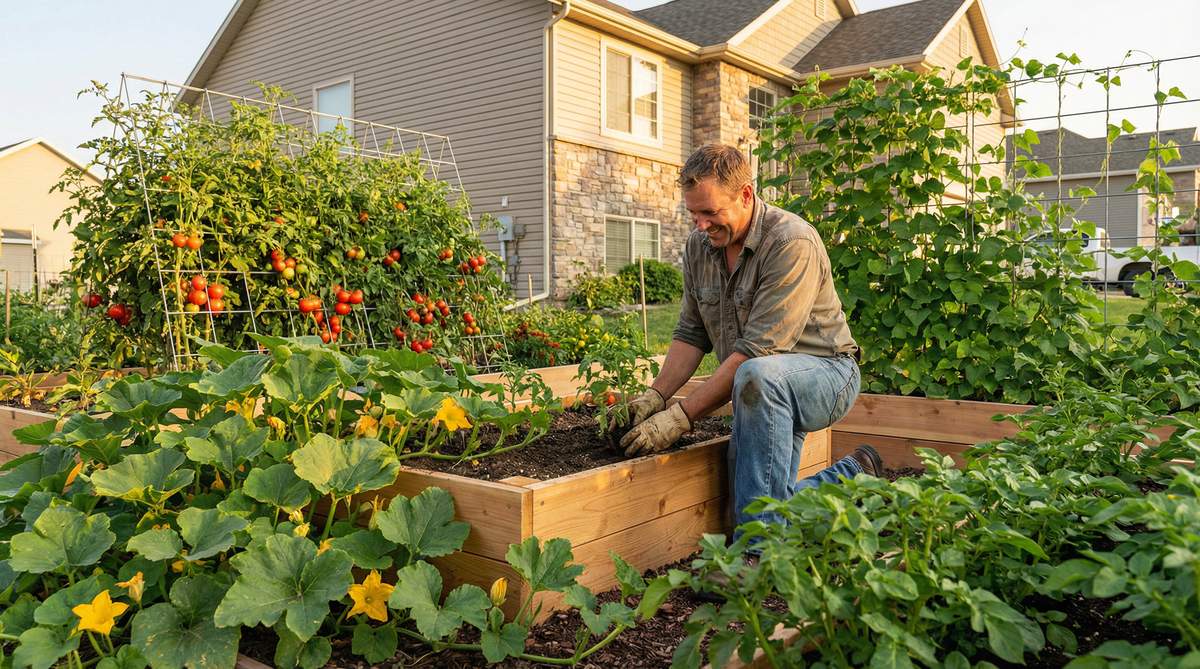
Instead, build three 4×8 foot raised beds.
This gives you roughly 100 square feet of intensive growing space.
Using the square-foot gardening method, a well-managed bed can yield between 1 and 2 pounds of food per square foot.
That is up to 200 pounds of nutrient-dense food from a space smaller than a parking spot.
Step 2: The Caloric Foundation Crops
Do not waste space on lettuce and radishes.
You need calories, carbohydrates, and storability.
Plant potatoes, sweet potatoes, and winter squash.
These are survival staples. They are calorie-dense, require minimal maintenance, and can be stored for months without refrigeration.
A single 4×4 section of potatoes can yield 15 to 20 pounds of food.
Step 3: The Vertical Yield Multipliers
Grow your high-value crops vertically to maximize your footprint.
Pole beans, indeterminate tomatoes, and climbing peas should be trained up cattle panel trellises.
A single indeterminate tomato plant, properly trellised and pruned, can produce 20 to 30 pounds of fruit.
At current organic grocery prices, that one plant is worth over $100.
Step 4: The Closed-Loop Fertility System
You cannot rely on buying bagged fertilizer from the hardware store.
Those prices are skyrocketing right alongside commercial agricultural inputs.
You must build a closed-loop fertility system.
Start a hot compost pile immediately using kitchen scraps, yard waste, and autumn leaves.
Set up a simple vermicomposting (worm) bin in your garage or basement.
Worm castings are one of the most nutrient-dense, biologically active fertilizers on earth, and you can produce them for free.
The Real Costs and Returns
Setting up three 4×8 raised beds with quality soil and seeds will cost between $400 and $600.
But the return on investment is staggering.
In your first year, that $600 investment can yield over $1,500 worth of organic produce.
By year two, your startup costs are zero, your soil is richer, and your yields will increase.
You are effectively printing your own money in the form of food.
The Path to Resilience
The headlines are terrifying, but fear is a useless emotion.
Fear paralyzes. Action empowers.
When you plant a seed, you are making a declaration of independence.
You are stepping out of the fragile, hyper-connected global supply chain and taking ownership of your family’s survival.
You no longer have to panic when you see the news about the Strait of Hormuz.
You no longer have to stress when the price of beef jumps another 14 percent.
Because you have built a buffer.
You have transformed your backyard from a useless patch of grass into a biological engine of resilience.
This is what true sovereignty looks like.
It is not about hiding in a bunker.
It is about building systems that sustain you, regardless of what the economy or the government does.
The window to act is open right now.
The soil is warming up. The spring rains are here.
Do not let this season pass you by.
The Blueprint for Independence
Building a resilient life requires a comprehensive strategy across every domain of your existence.
If you want the exact, step-by-step system for turning any small space into a high-yield food engine, you need the 4ft Farm Blueprint. It is the ultimate guide to food sovereignty, showing you how to grow a massive supply of calories in a fraction of the space of a traditional garden.
But food is only one piece of the puzzle. To secure the physical tools, off-grid gear, and essential equipment required to maintain your homestead when the supply chain fails, equip yourself at Homesteader Depot.
You also need the tactical intelligence to stay ahead of the next crisis. The Self Reliance Report provides the critical preparedness strategy and early warning systems you need to protect your family before the herd panics.
Because this food crisis is ultimately an economic crisis, you must understand the macro forces driving the collapse. American Downfall delivers the unfiltered political and financial analysis required to navigate the coming stagflation and protect your wealth. And if you want to understand how to build a personal alternative currency and barter system when the dollar loses purchasing power, that foundation starts here.
Finally, true independence is impossible without physical vitality. You cannot defend your family or work your land if your body is failing. Discover the natural health protocols and alternative medicine strategies at Seven Holistics to build a resilient immune system.
And to completely decouple yourself from the fragile, pharmaceutical-dependent medical system, implement the health independence strategies found at Freedom Health Daily.
The system is breaking.
Build your stronghold today.