
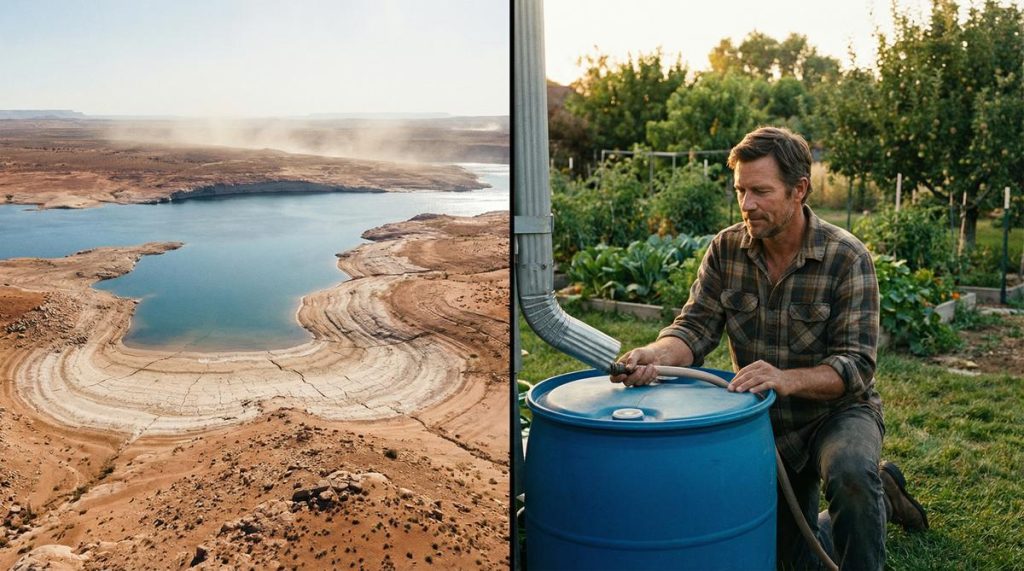
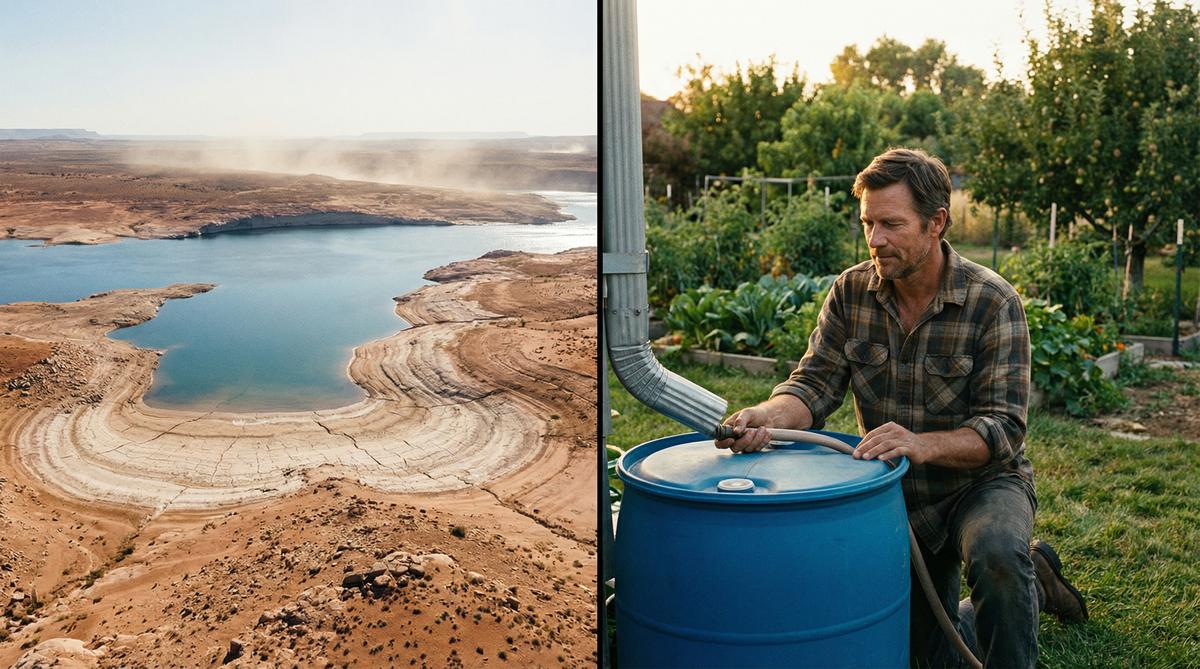
The American West is running out of water, and the timeline for collapse just accelerated.
As of April 2026, Lake Powell has plummeted to just 23.5% of its capacity.
Lake Mead sits at a terrifying 34% full.
These aren’t just statistics on a government website.
They are the lifeblood of 40 million Americans.
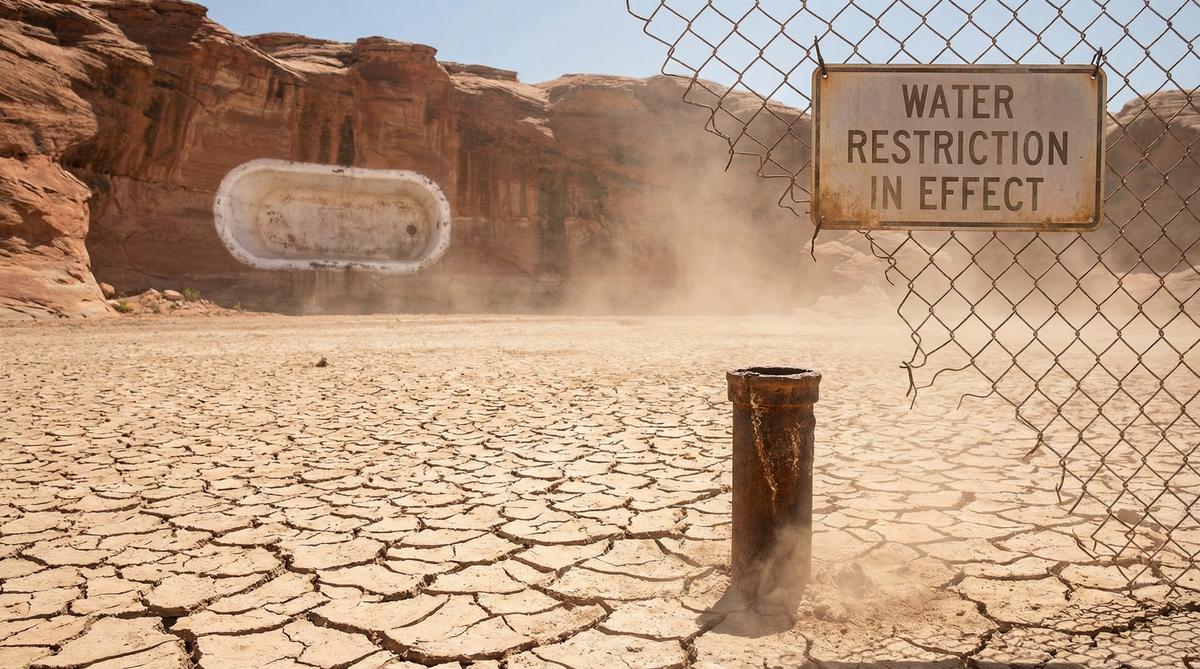
And the rationing has already begun.
In Denver, restaurants are now legally forbidden from serving water unless explicitly requested.
In Erie, Colorado, residents have been ordered to slash water usage by 45%—with officials threatening to shut off the tap altogether for violators.
The federal drought monitoring system confirms that more than half of the Western United States is currently baking under severe drought conditions.
The Bureau of Reclamation has already drafted plans for aggressive, mandatory cuts to Colorado River water usage.
When the government starts measuring your water by the drop, you no longer own your property—you are merely leasing survival from the state.
The illusion of infinite water is shattering in real-time.
For decades, Americans have operated under the assumption that turning a handle guarantees clean, endless water.
But that assumption is built on a foundation of sand.
The Colorado River, which sustains major urban centers from Denver to Los Angeles, has lost 20% of its flow over the past two decades.
Snowpacks in the Rocky Mountains are hitting record lows, meaning the slow, steady melt that usually refills reservoirs throughout the summer simply isn’t coming.
Instead, early-season heat waves are causing what little snow remains to evaporate or run off too quickly to be captured.
This isn’t a temporary dry spell.
This is a structural failure of the American water supply.
And when the system fails, the government will not prioritize your family.
They will prioritize industrial agriculture, energy production, and political donors.
If you rely entirely on the grid for your water, you are entirely at the mercy of the grid’s failures.
The Reality Check: Why Municipal Water is a Fragile Illusion
Most Americans operate under a dangerous delusion.
They believe that municipal water systems are robust, permanent fixtures of modern life.
But these systems are incredibly fragile, single points of failure.
They rely on aging infrastructure, massive energy inputs, and political agreements that are currently tearing themselves apart.
Consider the sheer complexity required to deliver water to your home.
It requires massive pumps running on grid electricity.
It requires chemical treatment plants that rely on fragile supply chains for chlorine and fluoride.
It requires thousands of miles of decaying pipes, many of which are decades past their intended lifespan.
When any one of these components fails, your tap runs dry.
And the failures are accelerating.
Between chemical contamination, failing treatment plants, and historic droughts, the municipal water supply is no longer a guarantee.
It is a liability.
Furthermore, the legal framework governing water rights in the West is a century-old relic that is entirely unequipped to handle the current crisis.
The 1922 Colorado River Compact allocated more water than the river actually produces.
Now, seven states are locked in a bitter legal battle over a shrinking pie.
When the Bureau of Reclamation imposes its mandatory cuts in 2027, the political fallout will be unprecedented.
True independence is impossible if someone else controls your access to the most vital resource on earth.
You cannot claim to be self-reliant if a bureaucrat in Washington can turn off your water supply with the stroke of a pen.
You cannot protect your family if your ability to hydrate depends on a fragile, over-leveraged system.
The only rational response to this crisis is to build your own supply.
You must become your own water utility.
The Practical Solution: Building Your Own Rainwater Harvesting System
You don’t need to wait for the government to shut off your tap.
You can build your own water sovereignty right now.
Rainwater harvesting is the ultimate act of defiance against a fragile system.
And despite the persistent rumors, collecting rainwater is legal in all 50 states.
While a few states, like Colorado and Utah, have specific capacity limits or registration requirements, the vast majority of Americans can harvest rainwater without restriction.
Here is exactly how you build a reliable, off-grid water collection system.
Step 1: Calculate Your Yield
The math is staggering. Just one inch of rain falling on a 1,000-square-foot roof yields 600 gallons of water.
Even in arid climates, a standard home can capture thousands of gallons annually.
To calculate your specific potential, multiply the square footage of your roof by 0.623, and then multiply that number by your average annual rainfall in inches.
The result is the total number of gallons you can harvest every year.
For most homes, this number is more than enough to supplement municipal supply and provide a critical emergency buffer.
Step 2: Install a First Flush Diverter
This is the secret to clean water.
The first few gallons of rain wash bird droppings, dust, pollen, and debris off your roof.
If this initial runoff enters your storage tank, it will contaminate your entire supply, leading to algae growth and bacterial blooms.
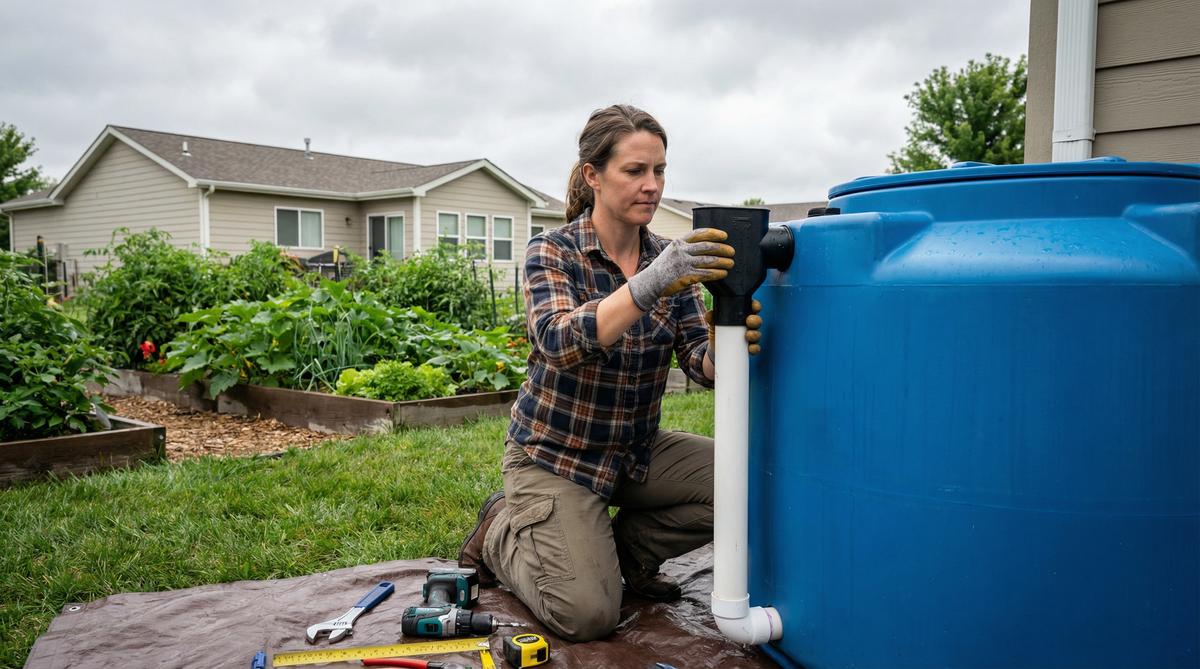
A first flush diverter automatically captures this dirty water in a separate PVC pipe, allowing only the clean, subsequent rain to flow into your main tank.
You can build one yourself for under $50 using standard plumbing parts, or purchase a pre-made kit.
This single component is the difference between a stagnant swamp and a pristine water reserve.
Step 3: Choose Your Storage
For beginners, a 55-gallon food-grade barrel is a great start (around $80-$140).
But for true resilience, you need an above-ground polyethylene cistern.
A 1,000-gallon tank costs between $800 and $1,500.
When installing a large cistern, you must prepare the site properly.
Water weighs 8.3 pounds per gallon, meaning a full 1,000-gallon tank weighs over four tons.
Place it on a leveled, compacted gravel pad or a reinforced concrete slab to prevent the tank from shifting or rupturing under its own weight.
Ensure the tank is opaque to block sunlight, which prevents algae growth, and make sure all inlets and outlets are screened to keep out mosquitoes and rodents.
Step 4: Filtration and Purification
Collected rainwater is excellent for gardens, livestock, and flushing toilets, but it must be purified before drinking.
Never drink untreated roof runoff.
Install a gravity-fed filtration system, such as a Berkey or Alexapure, for daily drinking water.
For a whole-house solution, you will need a multi-stage filtration system that includes a sediment filter, a carbon block filter, and a UV light purifier to neutralize bacteria and viruses.
This ensures that every drop of water entering your home is safe, clean, and entirely under your control.
The Path to Resilience
Building a water collection system isn’t just about survival.
It’s about sovereignty.
When you watch the rain fill your cistern, you aren’t just collecting water.
You are collecting peace of mind.
You are insulating your family from the chaos of political water wars and municipal failures.
Every gallon you store is a gallon the system cannot leverage against you.
This is how you take your power back.
You stop relying on fragile infrastructure and start building your own.
You become the master of your own supply chain.
The psychological shift that occurs when you achieve water independence is profound.
You no longer look at a storm as an inconvenience; you look at it as a deposit into your family’s security account.
You no longer worry about municipal boil-water advisories or chemical spills.
You know exactly where your water comes from, exactly how it is filtered, and exactly how much you have in reserve.
This level of control is the foundation of true preparedness.
It allows you to focus your energy on building wealth, developing skills, and protecting your family, rather than worrying about the basic necessities of life.
The water crisis in the West is a warning to the rest of the country.
The era of cheap, abundant, and reliable municipal water is ending.
The future belongs to those who build their own infrastructure.
The Blueprint for Independence
Water sovereignty is just the first pillar of true independence. To secure your family’s future, you must build resilience across every aspect of your life.
If you want to turn that harvested water into a sustainable food supply, the 4ft Farm Blueprint shows you exactly how to grow six months of food in a fraction of the space, insulating you from grocery store shortages.
For the heavy-duty gear, filtration systems, and tools required to build your off-grid infrastructure, Homesteader Depot has everything you need to get the job done right.
To stay ahead of the next crisis and receive actionable intelligence on grid vulnerabilities and economic threats, join the Self Reliance Report.
Understanding the political forces driving these resource shortages is critical; American Downfall provides the unfiltered economic analysis you won’t find on the evening news.
True resilience also requires physical vitality, which is why Seven Holistics offers the natural health solutions necessary to thrive outside the medical matrix.
And for daily strategies on maintaining your physical independence when traditional systems fail, Freedom Health Daily is your essential guide to medical self-reliance.
The water is drying up. The time to build your stronghold is now.